
Beyond the Horizon: Metro Dominance, Grassroots Surges, and the New Era of Philippine Youth Sports at Palarong Pambansa 2026
The dust has finally settled over the pristine tracks and state-of-the-art swimming pools of the Datu Lipus Makapandong Sports Complex in Prosperidad, Agusan del Sur. The 66th Palarong Pambansa, which ran from May 24 to May 31, 2026, was historic not just for its geographic setting. This brought the nation’s premier inter-regional youth sports event into the heart of the Caraga region—but also for the fascinating statistical stories written across the final medal tallies.
An analysis of the final results in the Regular Sports division reveals a sporting landscape in transition. While the powerhouse status of metropolitan hubs remains uncontested, a deep dive into the elementary and secondary divisions exposes shifting tides. The rising provincial giants, and systemic differences in grassroots athletic development across the Philippines can be felt.
The Macro View: NCR’s Untouchable Dynasty Continues
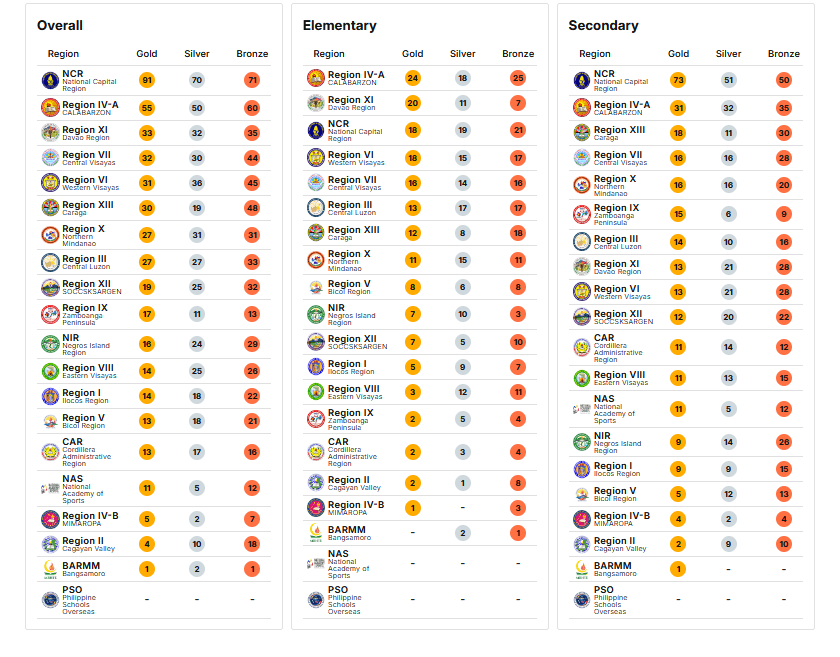
At the absolute peak of the mountain sits the National Capital Region (NCR). Securing an overwhelming 91 Gold, 71 Silver, and 71 Bronze medals (a total of 233 podium finishes), Metro Manila’s student-athletes proved once again why they remain the standard-bearers of Philippine youth sports.
NCR’s dominance is anchored on centralized sporting infrastructure, accessibility to elite coaching academies, and a highly competitive collegiate junior circuit. Sports entities such as the UAAP and NCAA) at filters top-tier talent directly into the Palaro ecosystem. However, a closer look at the overall standings indicates that while NCR reigns supreme, the gap is no longer completely unbridgeable.
Region IV-A (CALABARZON) comfortably consolidated its spot as the primary antagonist to NCR’s empire, capturing 55 Golds, 50 Silvers, and 60 Bronzes. The industrialized powerhouse of Southern Luzon benefits from a unique geographical sweet spot. Close enough for Metro Manila to cross-pollinate with elite training programs, yet large and independent enough to nurture deep provincial talent pools.
The Elementary Division: A Blueprint for Provincial Rebellion
If the overall tally suggests predictable big-city dominance, the Elementary Division completely shatters that narrative. It is here, at the foundational level of youth sports, where regional development programs bear their purest fruits.
The Rise of CALABARZON and Davao Region
In a stunning turn of events, NCR did not win the elementary division. Region IV-A (CALABARZON) claimed the top spot with 24 Gold medals, closely followed by Region XI (Davao Region) with 20 Golds. NCR was relegated to third place with 18 Golds, tying with Region VI (Western Visayas).
| Region Top 5 (Elementary) | Gold | Silver | Bronze |
| Region IV-A (CALABARZON) | 24 | 18 | 25 |
| Region XI (Davao Region) | 20 | 11 | 7 |
| NCR (National Capital Reg.) | 18 | 19 | 21 |
| Region VI (Western Visayas) | 18 | 15 | 17 |
| Region VII (Central Visayas)| | 16 | 14 | 16 |
This structural inversion is highly telling. At the elementary tier, raw athletic potential and early-childhood sports grassroots programs matter far more than corporate sponsorships or high-end facilities.
- Davao Region’s explosive 20-gold haul in the elementary bracket points to highly effective Mindanao-based local government unit (LGU) sports clinics.
- Western and Central Visayas maintaining 18 and 16 golds respectively confirms that the Visayan core remains a hotbed for foundational athletics, particularly in events that reward agility and endurance.
The fact that NCR dropped to third in this division suggests that provincial public school systems and regional sports hubs are doing an exceptional job identifying talent early.
The Secondary Division: The Capital Strikes Back
The narrative shifts dramatically when transitioning to the Secondary Division. Here, the National Capital Region did not just win; they executed a total demolition of the field.
NCR hoarded a jaw-dropping 73 Gold medals in the high school bracket—more than double the output of their closest competitor, CALABARZON (31 Golds).
The Secondary Talent Drain
Why does the competitive balance swing so violently from elementary to secondary? The answer lies in the structural reality of Philippine sports: scouting and recruitment.
Between the ages of 12 and 16, standout elementary athletes from the Visayas and Mindanao are heavily recruited by elite Metro Manila high schools offering athletic scholarships, superior facilities, and pathways to collegiate glory. This “talent drain” manifests clearly in the medal count. The raw talent nurtured by Region XI or Region VI at the elementary level frequently ends up standing on the podium wearing NCR blue and gold by the time they reach high school.
Despite this talent siphon, Region XIII (Caraga) emerged as an inspirational outlier on their home turf. Nabbing 18 Golds to finish third in the secondary division, the host region converted home-court advantage, intense local pride, and newly built facilities into a historic performance, outperforming established powerhouses like Central Visayas (16 Golds) and Northern Mindanao (16 Golds).
Deep-Dive Analysis: Promising Trends and Glaring Disparities
A comprehensive analysis of the full 2026 table highlights several critical takeaways for the future of sports development in the country:
- The Consistency of the Visayan Bloc: Region VII (Central Visayas) and Region VI (Western Visayas) finished 4th and 5th overall, separated by just one gold medal (32 vs 31). Their balanced performance across both elementary and secondary divisions highlights sustainable, deeply ingrained sporting cultures in track and field, football, and combat sports.
- The Host’s Breakthrough: Finishing 6th overall with 30 Gold medals, Region XIII (Caraga) proved that investing in world-class facilities yields immediate competitive returns. The Datu Lipus Makapandong sports infrastructure didn’t just host the games; it galvanized a region.
- The Developing Sectors: Specialized institutions like the National Academy of Sports (NAS) pulled a respectable 11 Golds—exclusively in the secondary division—validating the state’s targeted approach to elite student-athlete development. Conversely, regions like BARMM (1 Gold overall) and MIMAROPA (5 Golds overall) continue to lag behind, signaling an urgent need for targeted Department of Education (DepEd) interventions and resource allocation to address systemic geographical sports disparities.
The 2026 Palarong Pambansa in Agusan del Sur will be remembered as the games where the provinces proved they could match the capital’s foundations. The elementary division results send an unambiguous message: the raw athletic future of the Philippines is local, decentralized, and thriving in the fields of Southern Luzon, the coastlines of the Visayas, and the highlands of Mindanao.
As the hosting torch passes to Quezon City for the next edition, the challenge for sports administrators is clear. To truly globalize Philippine athleticism, the country must bridge the gap between high school recruitment and provincial development, ensuring that the brilliant sparks lit in the elementary divisions of Agusan del Sur burn just as brightly all the way to the international stage.

